

When you enter a restaurant, the first things that come to your mind are most likely the menu, the food’s taste, the atmosphere, and the service. The words spoken by the restaurants might seem professional jargon, yet, they are all to the end of having the restaurant running in a smooth manner. One of such crucial words in the food and beverage (F&B) industry is “cover”.
To be aware of cover is to be aware of how restaurants figure out their business, plan staff schedules, develop food and beverage, and do performance analysis to arrive at these conclusions.
This comprehensive guide will take you through a journey of what covers are, why they matter, how restaurants calculate them, and how they affect the overall restaurant operations and profitability.
What Exactly is a Cover in a Restaurant?
In very basic terms:
A cover refers to the total number of one guest that has been served during a meal period in a restaurant.
It represents the very first measurement used to show how many customers dining in the establishment. Thus, it becomes easier for the restaurants to determine their business volume and also to make revenue estimations.
Some instances:
01. When a group of four people arrives for lunch, they will be recorded as 4 covers.
02. When a pair goes to the dinner table, it will be recorded as 2 covers.
03. When a lone diner is seated, one cover is counted equals.
It is simply a matter of counting the total number of diners served.
This is the way restaurants, cafés, hotels, and even fine-dining places refer to their daily operations.
The Significance of the Word "Cover" in Restaurants?
Actually, the idea of covers is not just about counting people, but also a very significant factor in planning, forecasting, and improving restaurant performance.
Helps Estimate and Forecast Revenue
Restaurants earn income based on the following variables:
01. Number of covers served
02. Average Per Cover (APC)
03. Frequency of seat turnover
If a restaurant from day to day, 120 covers is the number of guests served, it can easily draw a monthly revenue prediction that is very close to the actual one.
Assists in Staff Planning and Scheduling
A restaurant with a bigger crowd has to arrange a larger number of workers from different categories including:
01. Cooks
02. Wait staff
03. Dining area assistants
04. Clerical cashiers
05. Support staff for cleaning
Staffing that is done properly will lead to timely service which will also mean less waiting time and thus good customer satisfaction. However, on slow days the company would schedule fewer workers thus incurring less in labor costs.
Facilitates Inventory and Food Preparation
The kitchen might just require to prepare vegetables, meat and poultry, gravy and sauces, desserts, and beverages in the right amount with knowing the expected number of covers.
This will also mean:
01. No food shortage
02. No excess preparation
03. No waste of ingredients
Good inventory management is considered a factor that contributes to increased profits as it even eliminates the occurrence of unwanted kitchen costs.
Gives Assistance in Calculating Table Turnover
Table turnover simply refers to the number of times a particular table is used during a single meal period.
For instance:
Say a restaurant has 40 seats and serves 80 covers during dinner then that means the seating capacity was used 2 times.
A high table turnover equates to a higher profit
Performance Analysis and Comparison
Identifying and analyzing covers is one way restaurants use to know the main patterns and their performance levels:
01. weekdays vs. weekends business
02. lunch vs. dinner crowd
03. seasonal variations
04. festival rush
05. special event days
Tracking covers is a factor that enables restaurants to know the best times to offer:
01. discounts
02. combo offers
03. special menus
04. festivals or theme nights
This will lead to increased sales during the off-peak times.
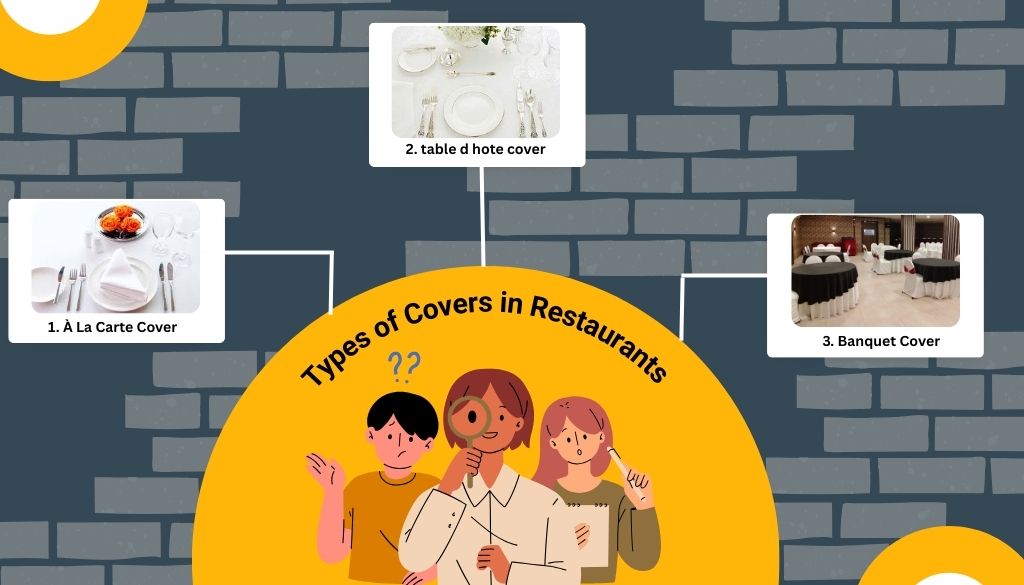
Types of Covers in Restaurants
Covers can be grouped according to dining setup or menu style.
À La Carte Cover
Customers have the liberty to choose items of their own selection from the menu.
For instance:
Starters, main course,
desserts are ordered separately.
This is seen in restaurants, cafés, and even in case of fine dining.
Table d hote cover
La table d’hôte or cover is a type of cover that indicates a set menu at a fixed price.
Some examples include:
01. Brunch
02. buffet
03. Weddings
04. Celebration thalis
The predefined quantity and menu items indeed help quite a bit in planning.
Banquet Cover
It is mainly for big events like:
01. Conferences
02. Corporate parties
03. Weddings
04. Social events
Here the number of guests determines:
01. The amount of food
02. Pricing of the menu
03. The number of staff needed
Generally, banquet covers are in large volume and need meticulous planning.
What is a Good Cover Count for a Restaurant?
A “good” cover count is influenced by several factors:
01. The capacity of the restaurant
02. Its location
03. Style of food
04. Price of the menu
05. Type of service (fast food, casual dining, fine dining)
06. Hours of operation
Usually:
01. An upscale restaurant tries to turn the tables during busy hours at least 1.5 to 2 times.
02. A café may have a lower Average Per Cover (APC) but higher covers due to the fast service.
03. More covers equal better sales. However, quality service must be ensured in order to lure repeat customers.
How Restaurants Increase Their Cover Count
Increasing the number of covers is equivalent to serving more guests, and thus directly lifting the revenue. The following are most potent tactics:
Enhance the Speed of Service
Quick service means faster tables, as there is no waiting time.
This results in more customers being accommodated within a specific duration.
Seasonal Discounts and Offers
Some examples are:
01. Discounted drinks at certain hours
02. Discounts on certain days of the week
03. Meals at combined prices
04. Free item of equal value upon purchase of one
These types of promotions keep the customers coming in, more so on days when business is slow.
Implement Online Booking Systems
With the help of online reservations, restaurants can:
01. Control the number of people coming in
02. Prevent long queues from forming
03. Provide customers with seamless experience
05. Ordered scheduling also leads to better staff productivity.
Improve Ambience and Comfort
A better ambience is a strong reason for drawing in the same customers again and again.
The following factors:
01. Lighting
02. Seating comfort
03. Sound/music
04. Cleaning
05. Decoration
Even though they are all different, they still have one thing in common—they contribute to the satisfaction of customers and their coming back, thus increasing the number of covers naturally.
Seasonal and Festival Menus
Menus that are made specially for:
01. Festivals
02. Holidays
03. Local celebrations
surely will attract more customers and therefore increase covers.
Use Digital Marketing to Attract Customers
Promotion across social media platforms:
01. Instagram
02. Facebook
03. Google
04. YouTube
05. Food blogs
All are efficient means for restaurants to reach a bigger audience. A strong online presence brings along more visitors and hence more covers.
Conclusion
Cover might appear to be an easy term but actually it is a vital aspect in the whole restaurant operation.
It signifies one guest that has been served, but it affects the entire business—revenue forecasting, staff planning, inventory control, table turnover, and performance assessment.
For restaurant owners, students studying hotel management, and F&B professionals mastering the concept of covers is the first step towards understanding how restaurants can maximize their profits while maintaining excellent customer service.
The effective tracking of covers by restaurants can lead to: Better resource planning, Less waste, Higher quality of service, Repeat customers, More profits.
Covers understanding is the very first step towards understanding the entire restaurant business.
Also Read: What Exactly Is a Multi-Cuisine Restaurant?